
You want flat, evenly cooked bacon; curling wastes meat and causes uneven crisping. Use a simple paper-towel press to apply uniform pressure and absorb excess grease before and during cooking. You’ll get oven, stovetop, and microwave steps plus troubleshooting so you can achieve consistent results.
Why Bacon Curls and What Causes Uneven Cooking
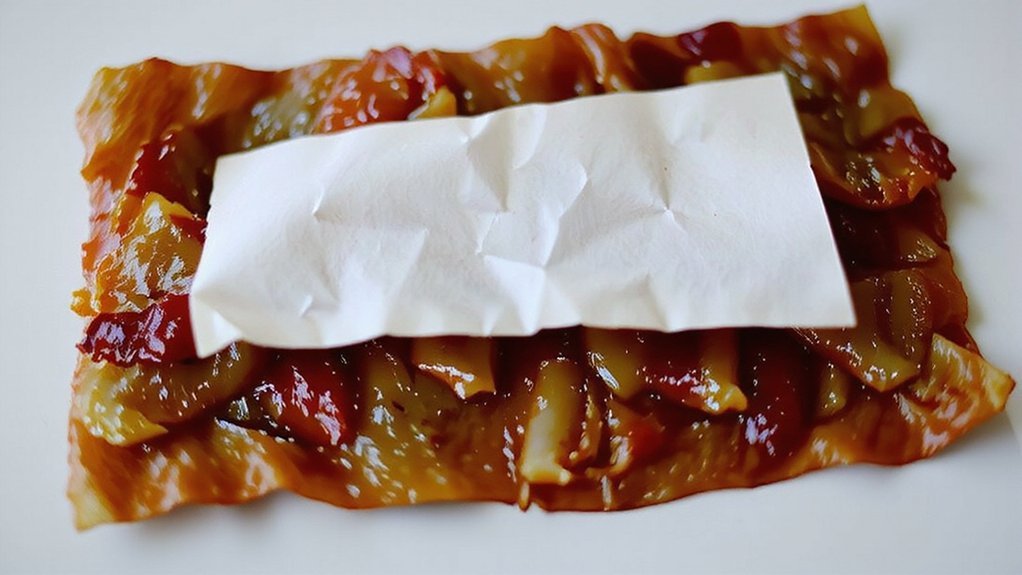
If you want flat, start with the physics: bacon curls because its lean muscle fibers and fatty layers contract at different rates when heated, causing the strip to warp. You can control curling by managing differential shrinkage: the strip’s Muscle fibers shorten and stiffen faster than fat, so uneven Fat rendering creates tension across the cross-section. You should monitor temperature ramp and surface contact to synchronize contraction and render fat uniformly. Use measured heat increments, consistent pan contact, and minimal agitation so thermal gradients stay low. Assess thickness and cure level; thicker or uneven cuts require slower, lower heat to avoid localized crisping. By quantifying heat flow and response, you innovate toward repeatable, flat outcomes. Record variables so you iterate toward ideal, consistent results.
The Paper Towel Trick Explained
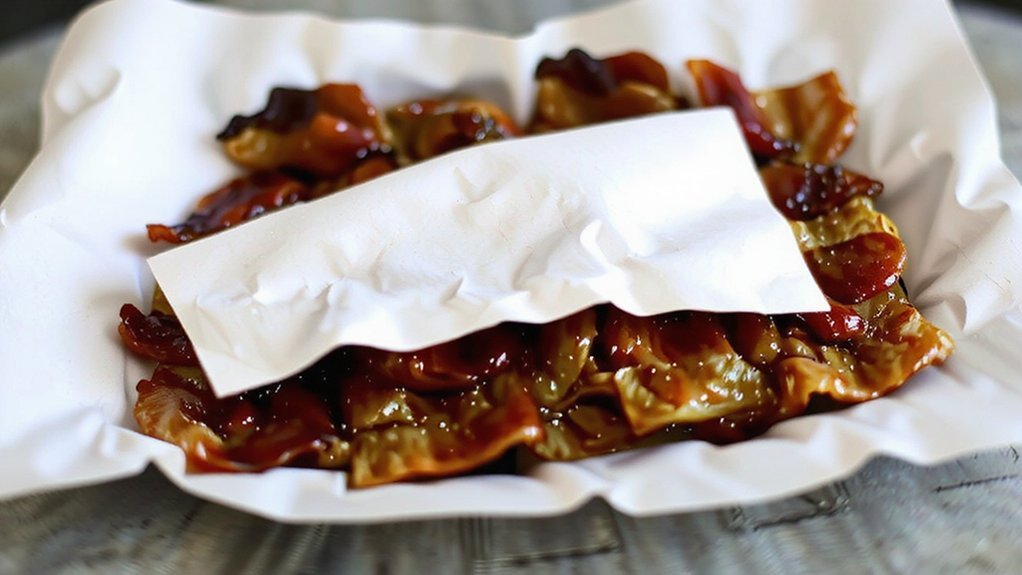
Bacon curls because the lean muscle and fatty layers contract at different rates as they heat, pulling the strip into a cup shape. You can use a paper towel to weigh the strips flat and absorb excess grease, which reduces uneven contraction. Place the towel directly over the bacon, pressing gently at the ends and center so the strips stay flat, and replace it if it becomes saturated.
Why Bacon Curls
When strips heat unevenly, they curl because the lean muscle fibers contract more than the surrounding fat and connective tissue, causing the edges to pull upward. You can predict curling by evaluating composition: thicker muscle bundles tighten and render dimensional change, while interleaved fat softens and slides. Thermal gradients create differential shrinkage along length and across width. Residual connective tissue and salt affect rigidity, increasing tendency to arch. In practice you evaluate raw strip geometry and expected heat flux to anticipate deformation rather than react. This explanation reframes culinary folklore about “why bacon curls” into measurable variables tied to material response and visual aesthetics. Use that framework to design interventions focused on equalizing thermal stress and stabilizing geometry before cooking for consistent results reliably.
Paper Towel Placement
You can prevent curling by absorbing surface moisture and applying gentle, uniform pressure with a paper towel. Place a single sheet over raw strips, aligning towel edges with bacon ends so corner alignment is consistent across the pan. Fold only if needed to match strip length; avoid bulk under centers. Note perforation direction: lay towels so perforations run parallel to strip grain to minimize snagging and fluid pooling. Press evenly with flat palm for five seconds per strip, then transfer to cold pan or baking rack without rehandling. Replace saturated towels immediately to maintain absorption. For batch cooking, stack strips with separate towels between layers, maintaining corner alignment and perforation direction for repeatable results. This method balances moisture control and structural support and consistency.
Preparing Bacon for Oven Cooking
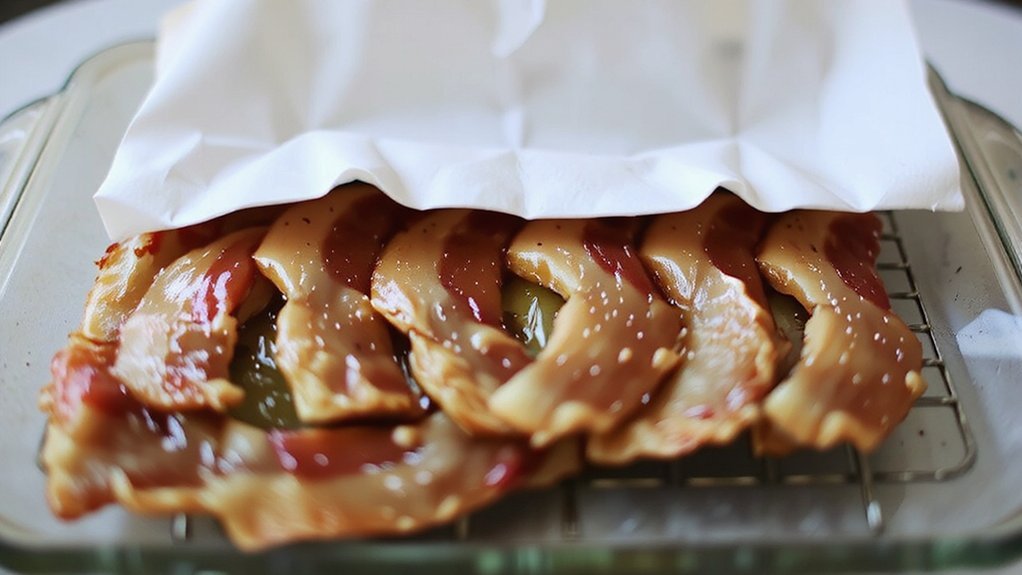
Laying strips flat on a rimmed baking sheet lined with foil or parchment prevents crowding and helps maintain even contact so slices stay flat. You preheat oven to 400°F, align strips parallel, and leave space for airflow. For innovation, test seasoning variations sparingly: black pepper, smoked paprika, or brown sugar, applied lightly. Complete equipment prep: use oven mitts, a rack if you want extra drainage, and a thermometer.
| Tool | Purpose |
|---|---|
| Rack | Drain fat |
| Foil/parchment | Easy cleanup |
Bake 12–18 minutes depending on thickness, rotating the pan halfway for uniform results. Remove when edges are crisp but not burnt, and let rest on a cooling rack briefly to set shape. The method minimizes curl through consistent contact, regulated heat, and controlled seasoning for reproducible flatness always.
Using Paper Towels on the Stovetop
If you use paper towels to absorb excess grease from stovetop bacon, fold two to three sheets into a compact pad, pat slices briefly with tongs to blot fat, and place soiled towels in a metal or heatproof container away from burners to cool; don’t leave them on or near a hot element. Work systematically: cook on moderate heat to reduce spattering, transfer strips to a rack briefly so remaining oil drains, then blot once to remove surface fat. Use tongs and a small tray to maintain distance from flame. For stovetop safety and responsible grease disposal, seal cooled towels and discard per local rules or pour strained grease into a sealed container for recycling. These steps limit curling and manage hazards effectively now.
Microwaving Bacon With the Paper Towel Method
When you microwave bacon between paper towels, you’re controlling splatter and helping flatten the strips. Arrange a single towel under the bacon and one over it, or use double layers to absorb extra grease. Start at about 1 minute per slice on high and add 30-second bursts until you reach the desired crispness, checking between bursts to prevent overcooking.
Layer Paper Towels
Layering paper towels between and over bacon strips absorbs fat and applies gentle pressure so the meat cooks flatter and curls less. You position one towel under the rack or plate, lay strips evenly without overlap, then cover with a single or double layer to balance pressure and soak. Conduct an absorbency comparison among towel types—single-ply, multi-ply, or specialty kitchen papers—to select material that traps grease without disintegrating. Change saturated towels mid-cycle if needed to maintain contact and avoid steam pockets. After cooling, treat used towels as contaminated waste; consider approved Recycling methods for cardboard products only if local rules permit; otherwise discard in landfill waste. Follow sanitary handling and experiment incrementally to refine layers for your microwave model. Document results for repeatability consistently.
Optimal Microwave Timing
Curious how long to cook bacon in the microwave without wasting time or burning it? You’ll start with consistent slices laid between paper towels, then use short pulse durations to control rendering and avoid curl. Begin at medium-high power for 30–40 seconds per slice, then test crispness; use 10–15 second pulse durations for finishing to prevent overshoot. If your microwave runs hot, implement power adjustments to 70% and extend cycles proportionally. Rotate the tray between pulses for even cooking. Record your microwave’s baseline and adjust times incrementally; innovation comes from systematic tweaks. This method minimizes trial-and-error, delivers uniform flat strips, and preserves texture—precise, repeatable timing yields predictable, curl-free bacon. Measure results, log settings, and refine parameters until you consistently achieve desired crispness and flatness.
Oven Baking Step-By-Step for Flat Slices
If you want perfectly flat bacon, preheat the oven to 400°F (205°C) and line a rimmed baking sheet with foil, then set a wire rack on top so you’ll cook slices elevated for even heat and fat drainage to minimize curling. Use convection settings if available and place a drip pan beneath to catch rendered fat; this reduces flare-ups and stabilizes temperature. Arrange bacon single layer, not overlapping. Bake 12–18 minutes depending on thickness; check at 12. Remove rack with tongs and transfer slices to paper towels briefly to absorb excess fat.
- Trust the process.
- Monitor time precisely.
- Keep spacing consistent.
- Use tools to control variables.
Document each run and measurements so you’ll iterate, refine parameters, and develop reproducible improvements for consistent flat slices reliability.
Tips for Achieving Even Crispiness
Balancing heat, fat, and airflow will give you the most even crispiness, so preheat the oven fully, arrange slices single‑layer on the wire rack with consistent spacing and orientation, and choose similar‑thickness pieces so they cook at the same rate. You should monitor slice thickness and position to anticipate fat rendering timelines; thicker pieces need lower heat slightly longer to render without burning edges. Rotate the rack midcycle to equalize oven hotspots, and use a thermometer to validate target surface temperature rather than relying on time alone. Drain rendered fat from the pan if pooling threatens to re-soak bases. For experimental gains, test small batches varying rack height and heating profile, record results, and apply a consistent protocol to larger batches for innovative crispiness.
Troubleshooting Common Curling Problems
Why is your bacon curling despite careful technique? You diagnose variables methodically: uneven fat distribution, heat gradients, and mechanical constraints. First, account for Packaging Variability — tight rolls or vacuum shapes pre-deform slices. Second, note Brand Differences in cut thickness and connective tissue that change shrinkage. Third, verify pan temperature uniformity and ridge contact; inconsistent heat creates differential contraction. Fourth, inspect paper towel application: too loose allows edge lift, too tight stresses fibers.
- Observe packaging shape before opening.
- Compare brands for consistent thickness.
- Calibrate your heat source and pan flatness.
- Adjust paper towel pressure incrementally.
You iterate tests, measure results, and integrate findings into an optimized, reproducible routine. Document each variable, then refine parameters to minimize curl predictably consistently now.
Storing and Reheating Flat, Cooked Bacon
Having reduced curling through controlled packaging checks, brand selection, heat calibration, and paper-towel pressure, you can now preserve that flat profile during storage and reheating. Cool strips rapidly on a wire rack to avoid moisture buildup, then layer between paper towels and place in a rigid container to maintain flatness. For longer storage, use freezer portioning: stack measured servings separated by parchment and vacuum-seal or use airtight bags. Thaw in the refrigerator to minimize condensation.
Reheat gently on a low oven rack or in a skillet with minimal oil to restore crispness without warping. Monitor temperature to prevent rapid fat rendering that causes curling. Document timing and temps so you can replicate the process and sustain consistent flavor preservation. Adjust variables and record results.
Conclusion
By covering bacon with a single layer of paper towel and applying even pressure, you prevent curling and absorb excess grease, yielding flat, uniformly cooked slices. For ovens, use a wire rack; for stovetops, press briefly and replace saturated towels; for microwaves, cook in short bursts and rotate. Monitor temperature, replace towels as needed, and batch with separators. You’ll get consistent crispness and predictable results when you follow these steps methodically every single time, reliably.